Hurricane Season 2025: What Catastrophe Response Teams Need to Know Now
After one of the most active and devastating hurricane seasons in recent memory, all eyes are on what 2025 will bring — and how (re)insurers, MGAs, brokers, and risk managers can better prepare.
Early forecasts signal an above-average season, and if 2024 taught us anything, it’s this: readiness can’t wait until landfall. From hurricane monitoring to post-storm decision-making, the tools you use and the data you trust will shape how quickly and confidently you respond.
At EigenRisk, we’re helping our clients meet that challenge — by giving them access to real-time event intelligence, historical scenario planning, and customizable impact reports that enable smarter, faster decisions.
Let’s break down what happened last year, what’s coming, and how you can use EigenPrism to stay ahead.
2024 Hurricane Season in Review: A Wake-Up Call
Despite advances in forecasting technology and stronger building codes, hurricane-related damage has tripled over the past few decades. The 2024 season was no exception—bringing a wave of destruction that underscored just how vulnerable we still are.
Key stats from the 2024 Atlantic season:
– 18 named storms
– 11 hurricanes
– 5 major hurricanes
– $110+ billion in total insured losses (U.S.)
Major events:
– Hurricane Helene: The deadliest storm since Katrina: 251 lives lost, $78.7 billion in damages.
– Hurricane Milton: A Category 4 system that struck Sarasota, FL, with an economic toll of $34.3 billion.
– Hurricanes Beryl, Debby, and Francine: These storms caused widespread flooding, displacement, and major losses across the Southeast.
These events weren’t anomalies — they’re part of a pattern of intensifying tropical activity, especially as ocean temperatures continue to climb.
2025 Outlook: What Forecasters Are Saying
Early seasonal projections points to a higher-than-average hurricane season, driven by:
– Above-normal Atlantic sea surface temperatures.
– Weakened El Niño conditions.
– Stronger West African monsoon activity.
According to NOAA, CSU and other forecasters, we could see:
– 15 to 20 named storms
– 7 to 11 hurricanes
– 3 to 5 major hurricanes (Category 3+)

While these numbers are projections, they reinforce a clear message: proactive risk planning is more critical than ever.
Prepare Smarter with EigenPrism
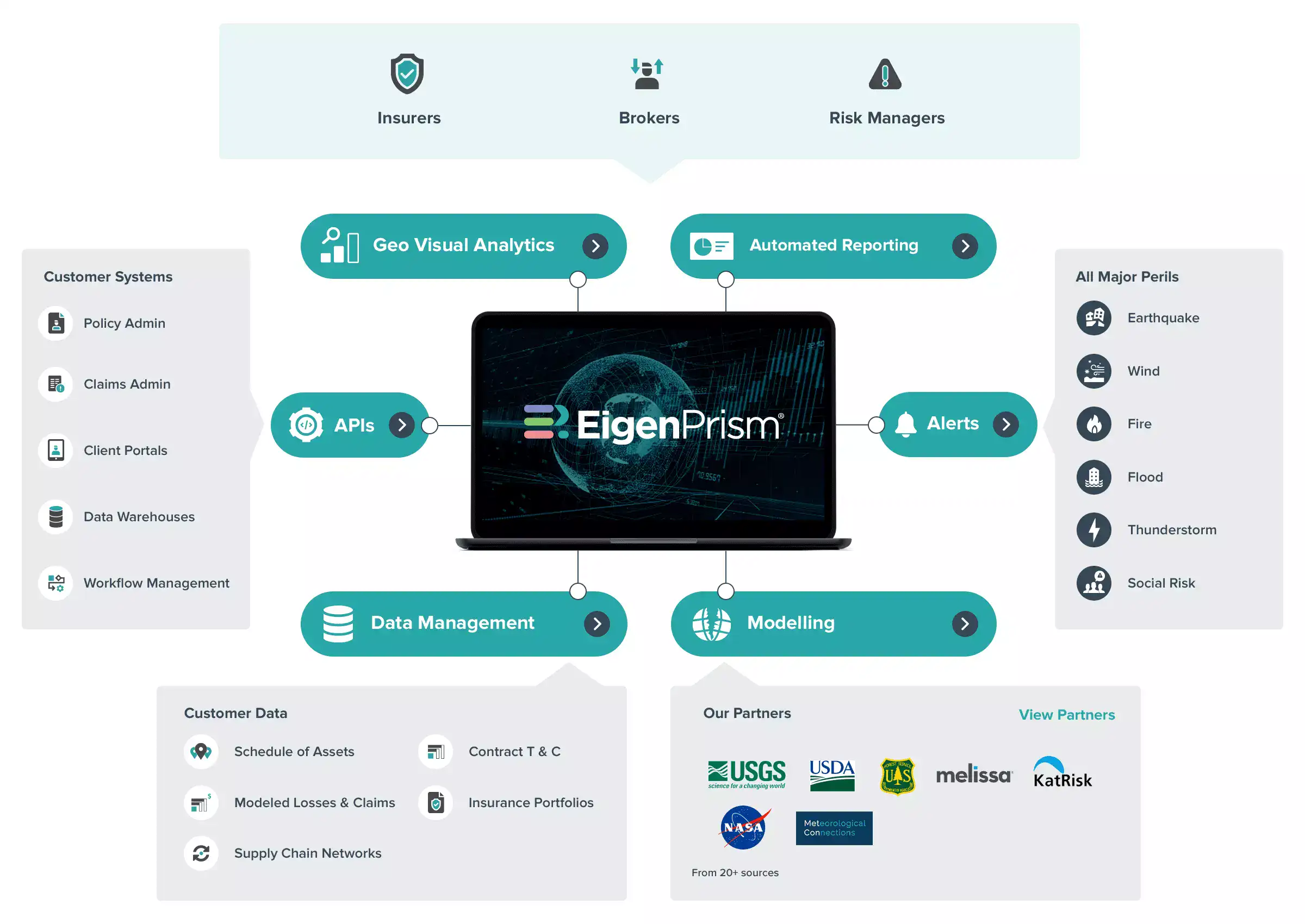
Whether you’re modeling loss exposure, evaluating storm scenarios, or preparing for claims triage, EigenPrism gives you the visibility and speed needed at every stage of the hurricane lifecycle.
Here’s how to get started:
1. Assess & Strengthen Your Exposure Data
Your ability to respond in real time hinges on the quality of your exposure data.
In EigenPrism, you can:
– Upload your exposure data (schedules of value or portfolios) in minutes.
– Enhance location-level intelligence with third-party data augmentation from 10+ data partners.
– Assess data quality in context of hazard maps to zero in on problem locations most likely to impact downstream analytics.

– Pinpoint high-accumulation zones using interactive geospatial analytics with fully integrated financial modeling

2. Run Pre-Landfall Scenario Simulations
– Instantly generate gross and net loss estimates across regions, treaties, or programs.
– Incorporate your historical loss experience with custom damage factors.
– Leverage granular intelligence to set and review moratorium thresholds.
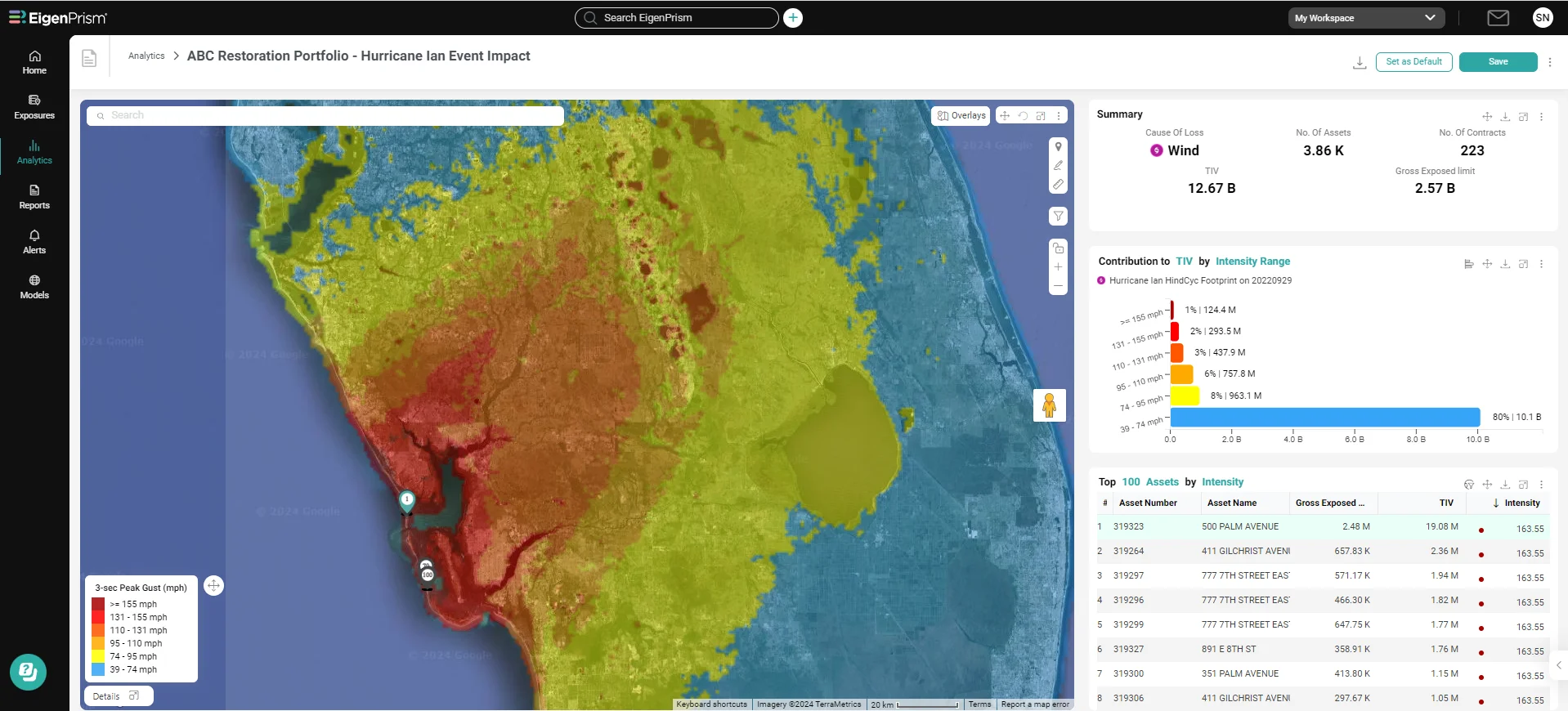
– Instantly generate gross and net loss estimates across regions, treaties, or programs.
– Take control of the loss estimates with custom damage factors.
Leverage granular intelligence to set and review moratorium thresholds.


3. Set Up Real-Time Alerts & Notifications
When a tropical depression rapidly intensifies into a Category 3 hurricane—like Hurricane Milton—speed matters.
With EigenPrism, you don’t have to wait and react. Our real-time alerts keep you ahead of fast-moving events by notifying you when a storm is likely to impact your portfolio.
Set customized alert thresholds based on your exposures, and receive updates only when it matters —so you can focus on action, not noise.
Stay informed. Stay ahead. That’s the EigenPrism advantage.

You can configure alerts for:
– Thresholds based on wind-speed, flood-depth or other event intensity metric specific to your exposes locations.
– Thresholds based on various financial measures like impacted TIV, gross/net limits or estimated losses.
– Get notified via email, SMS, or the EigenAlert mobile app — so you’re never out of the loop and get notified only when it matters!
Download the EigenAlert app here:

4. Post-Storm: Respond Faster, Report Smarter
As soon as storm data is available — whether it’s wind, surge, or flood — EigenPrism updates in real time. That means:
– Access to post-event footprints from public sources like NOAA, Adiabat, Hurricane mapping and premium sources like KatRisk, Reask, and ICEYE. Post event aerial imagery is also available on EigenPrism from sources like NOAA and Vexcel Data Program.
– Automated event impact reports for internal use or client distribution.
– Ability to export maps, summaries, and detailed analyses in CSVs for underwriters and adjusters.
– APIs to directly feed impact analytics into your claims and underwriting systems.
Why It Matters: Speed, Precision, Confidence
Storms are hitting harder, faster, and further inland. The ability to translate live weather data into business decisions is no longer optional — it’s a competitive advantage.
Whether you’re preparing renewals, protecting your book, or helping clients stay informed, EigenPrism empowers you to lead with clarity and speed.
What’s Next?
Already a client?
Log into EigenPrism and run a scenario simulation today.
Want to see how it works?
Request a demo and we’ll walk you through your own exposure data live.