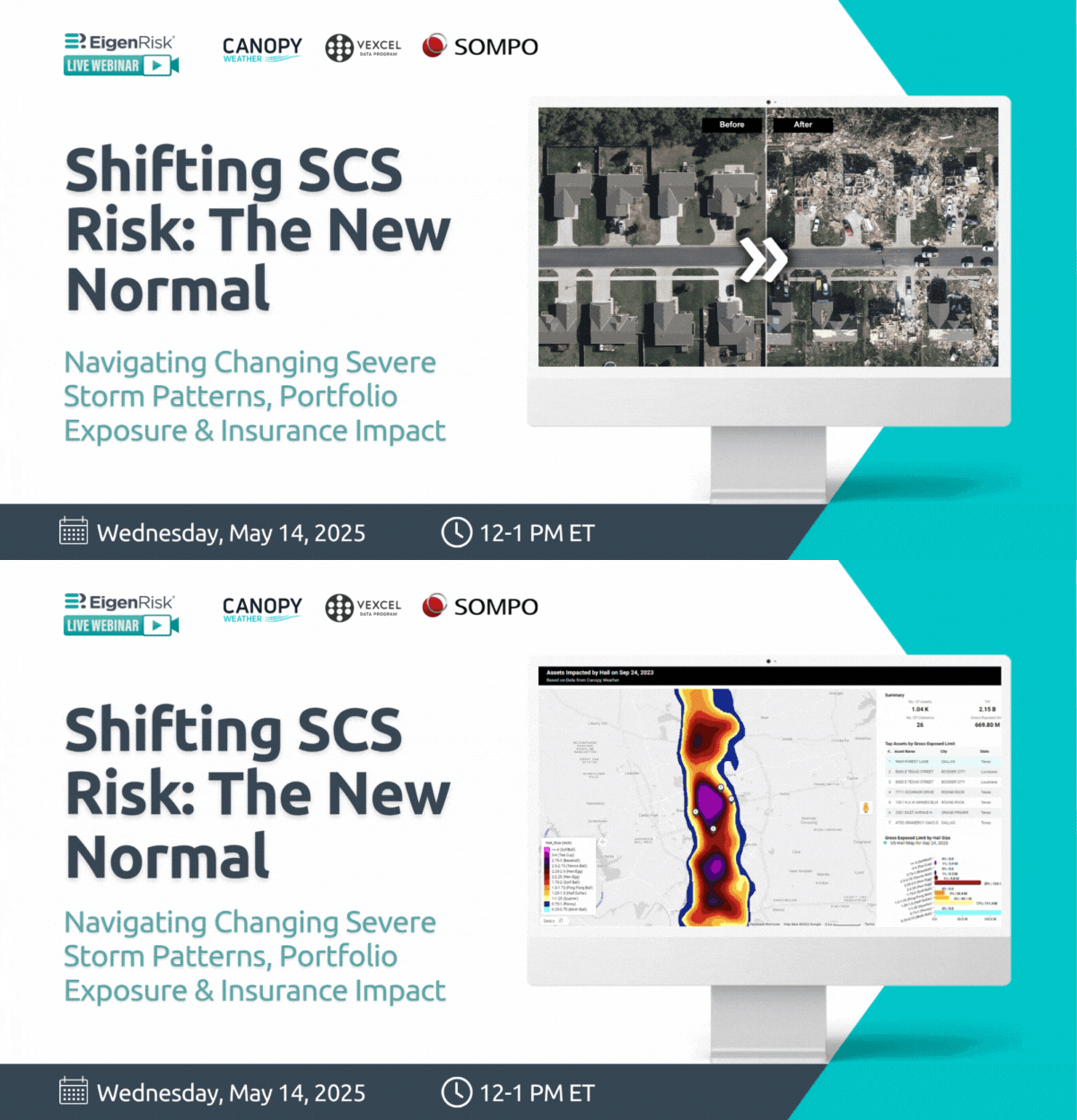
Shifting SCS Risk: The New Normal
Rising losses. Expanding risk zones. Discover how insurers are adapting to a surge in severe convective storms with smarter tools and real-time event intelligence.
With insured losses from severe convective storms in May alone expected to reach up to $7 billion, many carriers have been strengthening their ability to anticipate and respond to storm events.
A recent webinar featuring Don Giuliano, co-founder of Canopy Weather; Philip Whitman, sales director, Vexcel Data Program; Stu Kyle, vice president, Natural Claims Reporting at Sompo International; and Jon Sonnenschein, director of Business Development at EigenRisk examined trends in severe convective storms, new tools to track them and to respond to unfolding events faster and more effectively.
Giuliano began the discussion with an historical perspective on hail, wind, and tornadoes. He attributes the increase in the annual total tornado count dating back to 1950 to increased storm spotting. At the same time, he observed that the frequency of EF2 and more powerful storms have been on a slightly downward trend.
Elevated tornado risks
More significantly, however, he pointed out that the concentration of tornado events has been shifting away from what historically was considered Tornado Alley (stretching from Texas north to the Midwest) to states in the deep south, including Mississippi, Louisiana, and Alabama, as well as Tennessee and Illinois. These areas have seen elevated tornado risk in the past decade while there has been a decrease in tornado exposures in Texas and neighboring states.
Giuliano also observed significant changes in tornado frequency by season, especially in the South where there’s been an increase in tornadoes during the winter and at night. Generally, he noted summer tornados are on downward trend, while there’s been an increase in tornadoes in the fall, winter and spring.
More large hail events
With respect to hailstorms, Giuliano said large hail (greater than 1.75”) events are expected to become more common, while those involving smaller hailstones (less than 1.5”) have been decreasing. As a result, a single storm is more likely to result in significant damage.
In effect, he concluded: “The key takeaway is fewer pebbles and more baseballs,”.
In terms of geography, Giuliano observed there has been an increase in hail events throughout the U.S. Northeast into Canada.
Straight-line convective winds become stronger
With the increase in storm activity, Giuliano observed there’s been nearly a five-fold increase in geographic coverage of straight-line winds over the past 40 years, along with an increase in severity and coverage.
Next, Vexcel’s Whitman mentioned that Vexcel operates the largest aerial imagery program with a fleet of nearly 100 planes that cover some 29 million square kilometers in 40 countries. Vexcel has seven hubs in the U.S. from which it can stage and deploy aircraft. In addition, with an in-house pipeline to process all imagery captured, Vexcel can publish imagery within 24 hours after landing.
Before/after comparisons pinpoint damage
Claims teams can access Vexcel’s historical library to make before and after comparisons to generate timely damage assessments. Whitman described how the ready availability of damage assessments based on the imagery can help insurers accelerate their response in the aftermath of wildfires, tornadoes, and hurricanes.
Earlier this year, Vexcel ran damage assessments on nearly one million homes in the greater Los Angeles area following the wildfires; for Hurricanes Milton and Helene Vexcel conducted more than one million damage assessments for each event.
Streamlined disaster response using the EigenPrism platform
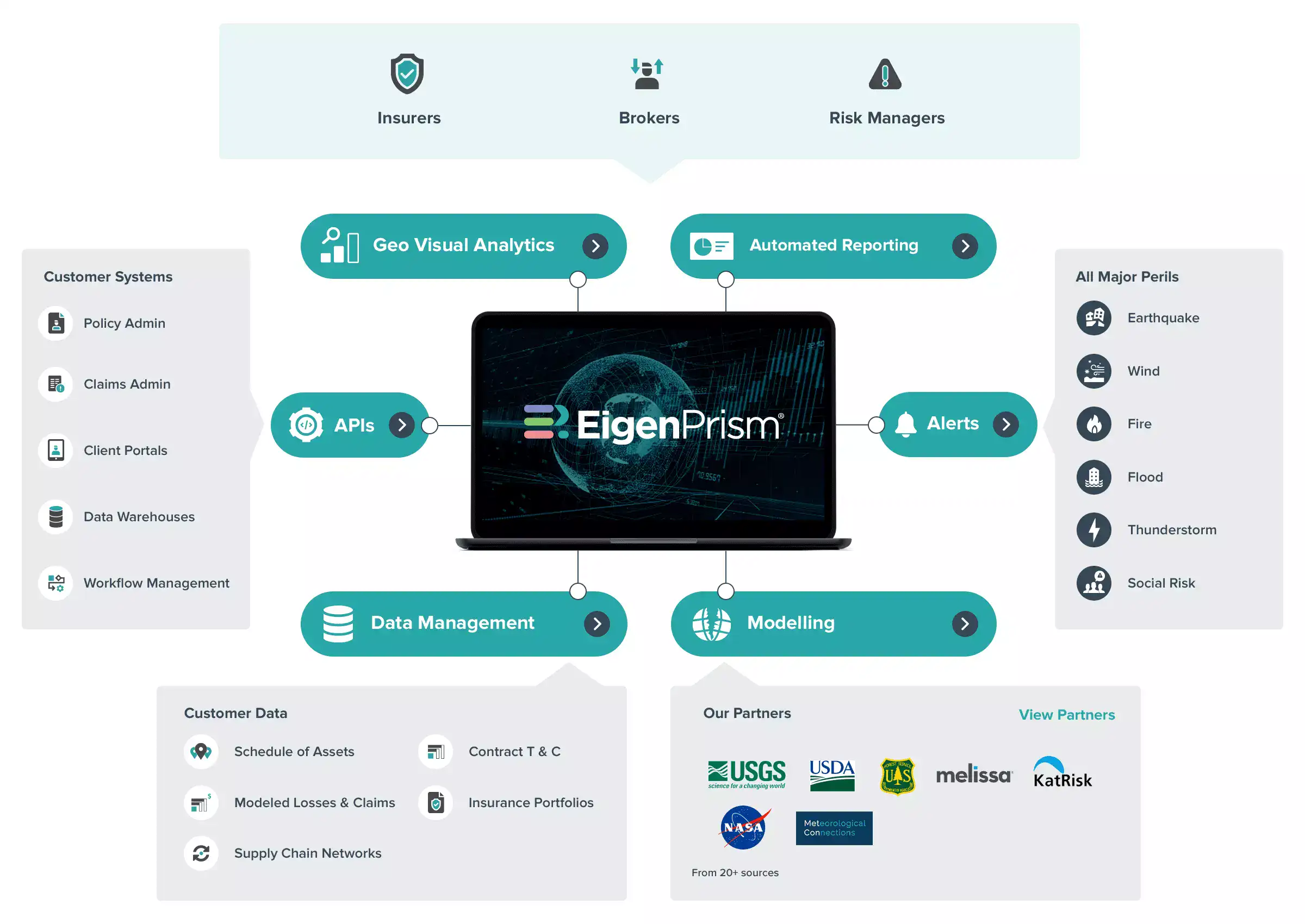
Before his team began using EigenRisk, Stu Kyle of Sompo International recalled the arduous and time-consuming process required for storm tracking, performing analytics, estimating loss potential and communicating loss estimates within the company.
At that point, Kyle said roughly 90 percent of his time was involved in obtaining storm data, checking news release, and matching relevant insured portfolio information before he could begin to analyze the potential impact of the event on the carrier’s book. Now, however, using the EigenPrism platform, he devotes about 10 percent of his time obtaining storm data and portfolio data from the platform and 90 percent of the time performing the analysis.
“It’s changed the quality of feedback I can give the company because I have so much more time to look at the results and think about … the business implications and what changes we can make and things we can do,” Kyle said.
Sonnenschein explained that each year EigenRisk looks at thousands of different events in all parts of the U.S., as well as across North America and around the world. Often, multiple events involving different perils occur simultaneously. So, for an insurer trying to keep up with thousands of potential loss events and near misses manually, it is not scalable. Thus, he noted, “That’s where the automated event response solution (provided by EigenRisk) really adds the most value.”
Setting automated event alerts in EigenPrism
Next, he showed how insurers can easily set automated alerts in EigenPrism, including options for receiving them as well as for establishing thresholds based on specified criteria, including peril, intensity, location, loss impact, and other criteria for when you want to be notified and how many alerts to receive on an unfolding event. Notably, claim teams can set alerts based on exposures that might directly impact their portfolios.
Sonnenschein and Kyle concluded with a demo of how Sompo International used Canopy Weather on EigenPrism to track a major SCS system that moved from Texas through Arkansas and into Missouri, resulting in a $36 million loss for the insurance industry. All perils associated with the storm were tracked on the platform and included tornadoes, hail and wind. As a result, Kyle and his team were able to follow the storm track and integrate imagery generated by Vexcel to show actual damage to specific properties.
Want to learn more?
To access the webinar, click here. To learn more about EigenRisk platform, please contact us: