Back-to-Back Billion-Dollar SCS Events in One Week. And the Peak Season Hasn’t Even Started Yet.
March 2026 has been a warning shot. The question is whether your team is positioned to act on it.
Gallagher Re confirmed that outbreaks on both March 10–12 and March 15–16 each qualified as billion-dollar-plus industry loss events, on top of separate notable outbreaks on March 4 and March 5–7. State Farm and American Family alone reported receiving more than 38,000 claims from earlier March weather.
The March 6 tornado outbreak that tore through a 1,500-mile corridor from Texas to Michigan was not an outlier. It was the opening act of what is historically the most destructive four-month stretch on the U.S. insurance calendar. March through June have accounted for at least 72% – more than $390 billion of U.S. SCS insured losses since 2010. And the peak period hasn’t even started yet.
SCS Is No Longer a Secondary Peril. The Data Has Settled That Argument
For years, severe convective storms were classified as secondary perils – high frequency, manageable severity, overshadowed by hurricanes and earthquakes on the catastrophe management agenda of carriers, reinsurers, and MGAs alike. That classification no longer holds.
According to Aon’s 2026 Climate and Catastrophe Insight report, severe convective storms have surpassed tropical cyclones to become the costliest insured peril of the 21st century, generating $61 billion in global insured losses in 2025 alone. On an aggregate basis since 2010, SCS at $542 billion has now well surpassed the tropical cyclone peril at $367 billion as the costliest for U.S. insurers.
Between January and September 2025, the U.S. experienced 39 SCS events with average insured losses exceeding $1 billion per event and average per-event costs running 31% higher than the previous decade.
For primary carriers, that means reserve pressure and portfolio repricing decisions arriving faster than workflows can support. For reinsurers, it means aggregate deductible erosion accelerating earlier in the season than treaties were historically designed to absorb. For MGAs and brokers, it means the accounts most exposed to SCS are the ones that need the most accurate, timely data at submission and at renewal. For risk managers, it means the cost of being unprepared is no longer a tail event, it is a seasonal certainty.
The numbers are clear. The strategic response across most carrier operations has not yet caught up.
The Sub-Peril Problem: Hail, Wind, and Tornado Are Not the Same Risk
One of the most persistent gaps in how the industry manages SCS exposure is treating it as a single event type. A convective storm system produces multiple simultaneous sub-perils, each with a distinct footprint, damage profile, and claims trajectory.
Research from Markel and the NAIC shows hail accounts for roughly 70% of annual SCS catastrophe losses, with wind and tornadoes responsible for 20%. In 2025, the U.S. recorded 142 days with damaging hail, above the 20-year average of 122 days, with hailstones two inches or larger striking more than 600,000 homes representing approximately $177 billion in reconstruction cost value.
A single outbreak can generate tornado claims in one state, hail claims across three others, and straight-line wind damage across an entirely different corridor — all within a 24-hour window. For carriers and MGAs managing mixed-peril books, for brokers trying to assess client impact quickly, and for reinsurers monitoring aggregate accumulation in real time, workflows that treat these sub-perils in isolation produce an incomplete picture at exactly the moment a complete one is needed.
The Response Gap Is Where Losses Compound
The financial toll of SCS does not only come from the storm itself. A significant portion of the damage (to reserves, to reinsurance programs, to underwriting decisions), comes from how slowly most teams are able to assess what happened.
National Weather Service damage surveys typically take two to seven days to publish after a tornado, and sometimes weeks during periods of active convective weather. By then, the window for a strategic, coordinated response has often passed. Claims are already being filed. Leadership is already asking questions the data has not yet answered. Brokers are fielding calls from clients without a clear picture of impact. Risk managers are trying to quantify exposure without footprints to work from.
SCS events are often highly localized and can develop rapidly with little notice, a characteristic that makes traditional approaches unreliable and leaves insurers with limited ability to respond at speed. The teams managing SCS exposure most effectively are not waiting for official surveys. They are working with high-resolution forensic hail, wind, and tornado data- updated in hours, not days, with automated alerts tied directly to their portfolios the moment an event footprint intersects their book.
That speed difference is not operational convenience. For carriers, it is a reserve accuracy advantage. For reinsurers, it is earlier visibility into aggregate erosion. For brokers and MGAs, it is the ability to proactively serve clients before they call with a claim. For risk managers, it is the difference between a reactive scramble and a structured response.
What the Rest of 2026 Is Likely to Bring
AccuWeather forecasters project 1,050 to 1,250 tornadoes across the U.S. in 2026, with an increased likelihood of severe thunderstorms producing damaging wind gusts and heavy downpours. The highest hail risk is expected from Texas to Alabama, with a secondary concentration across Iowa, northern Missouri, eastern Nebraska, and northeastern Kansas. “Do not let your guard down this severe weather season,” AccuWeather Meteorologist Alex Duffus warned. “Flash floods and damaging wind gusts can be just as destructive as tornadoes and often impact a much larger area. Tornado reports may trend lower than last year, but it only takes one storm striking a densely populated or vulnerable community to make this a devastating season.”
The geographic footprint of risk is also expanding beyond traditional Tornado Alley. The 2023 and 2024 storm seasons brought record-breaking hail events in Texas and Colorado and destructive tornado outbreaks in the Great Plains and Ohio Valley with significant events occurring in regions not historically considered high risk. As urban and suburban development has increased by 20% since 2000, more high-value assets are concentrated in storm-prone regions, amplifying the potential for large, multi-billion-dollar loss events.
April, May, and June are still ahead. For every segment of the P&C market – carriers managing mixed books, reinsurers monitoring aggregate attachment, MGAs and brokers with concentrated SCS exposure in their portfolios, and risk managers responsible for corporate property programs, the question is not whether the next major outbreak will happen. It is whether the response workflow is ready before it does.
Join EigenRisk and Canopy Weather on March 31 to Close Your SCS Response Gap

On March 31, 2026, from 12–1 PM ET, EigenRisk is hosting a live webinar, featuring Canopy Weather and BMS Re: “SCS: The New Costliest Insured Peril- Why Speed, Coverage, and Accuracy Matter Now More Than Ever.”
Deepak Badoni, Co-Founder and President at EigenRisk, will be joined by Donald Giuliano, Co-Founder of Canopy Weather, and Andrew Siffert, SVP and Senior Meteorologist at BMS Re, to cover:
- Why the SCS event response gap exists and what most teams are missing
- A three-pillar response framework: speed (hours, not days), coverage (including rural and underreported areas), and accuracy (high-resolution footprints validated against real outcomes)
- Post-event response strategies that leading (re)insurers and MGAs are deploying today, with real EigenPrism client examples from tornado and hail events
- A live introduction to Canopy Compass- a free platform providing county-level hail impact data available to you today
The next outbreak is not a question of if. It is a question of how ready your team is when it happens.
Register for the webinar — seats are limited.
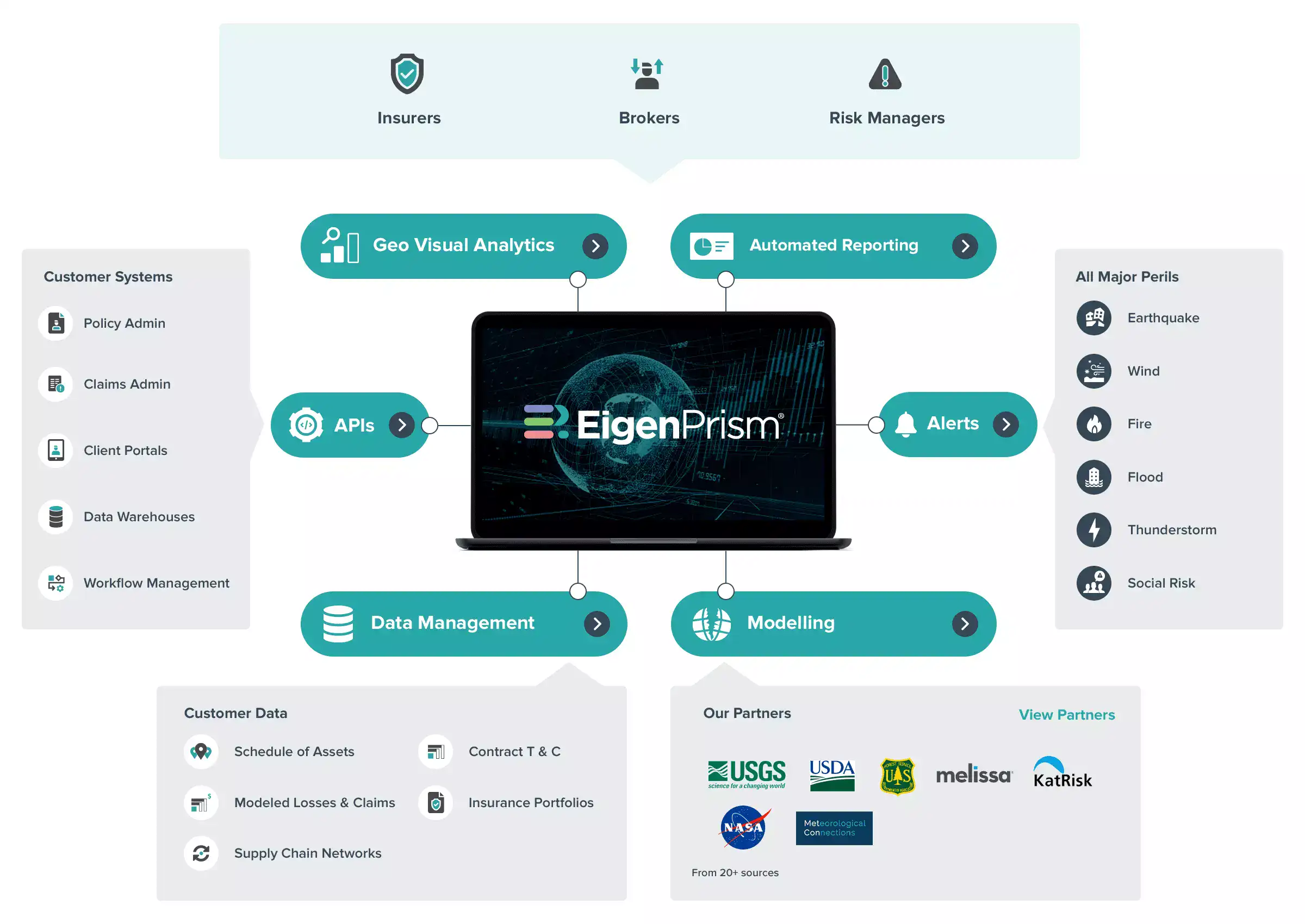
To learn more about how EigenPrism supports catastrophe event response and exposure management, contact us.