Severe Weather Season 2026: Your Pre-Season Checklist
Last year, severe convective storms accounted for $50 billion in global insured losses and a record 21 billion-dollar severe storm events in the U.S. alone. The March 13 to 16 tornado outbreak produced 118 confirmed tornadoes across more than a dozen states, causing $11 billion in damage. Weeks later, the April 2 to 7 outbreak added another 157 tornadoes and $4.1 billion in combined tornado and flood damage, much of it hitting the same areas.
These were not outlier events. Since 2020, cumulative SCS losses have consistently exceeded hurricane losses. Spring 2026 is here, and the window to prepare is now.
Here is how to make sure your EigenPrism setup is optimized for SCS season.
Step -1 Go into Storm Season with Exposure Data You Can Trust
Outdated exposure data leads to inaccurate impact assessments, missed alerts, and unreliable reports. Take these steps now to make sure you’re set for this season:
Re-import your Exposures
Property values, occupancy types, and construction details shift over time. If your Schedules of Values have not been refreshed recently, now is the time.
Automate with APIs
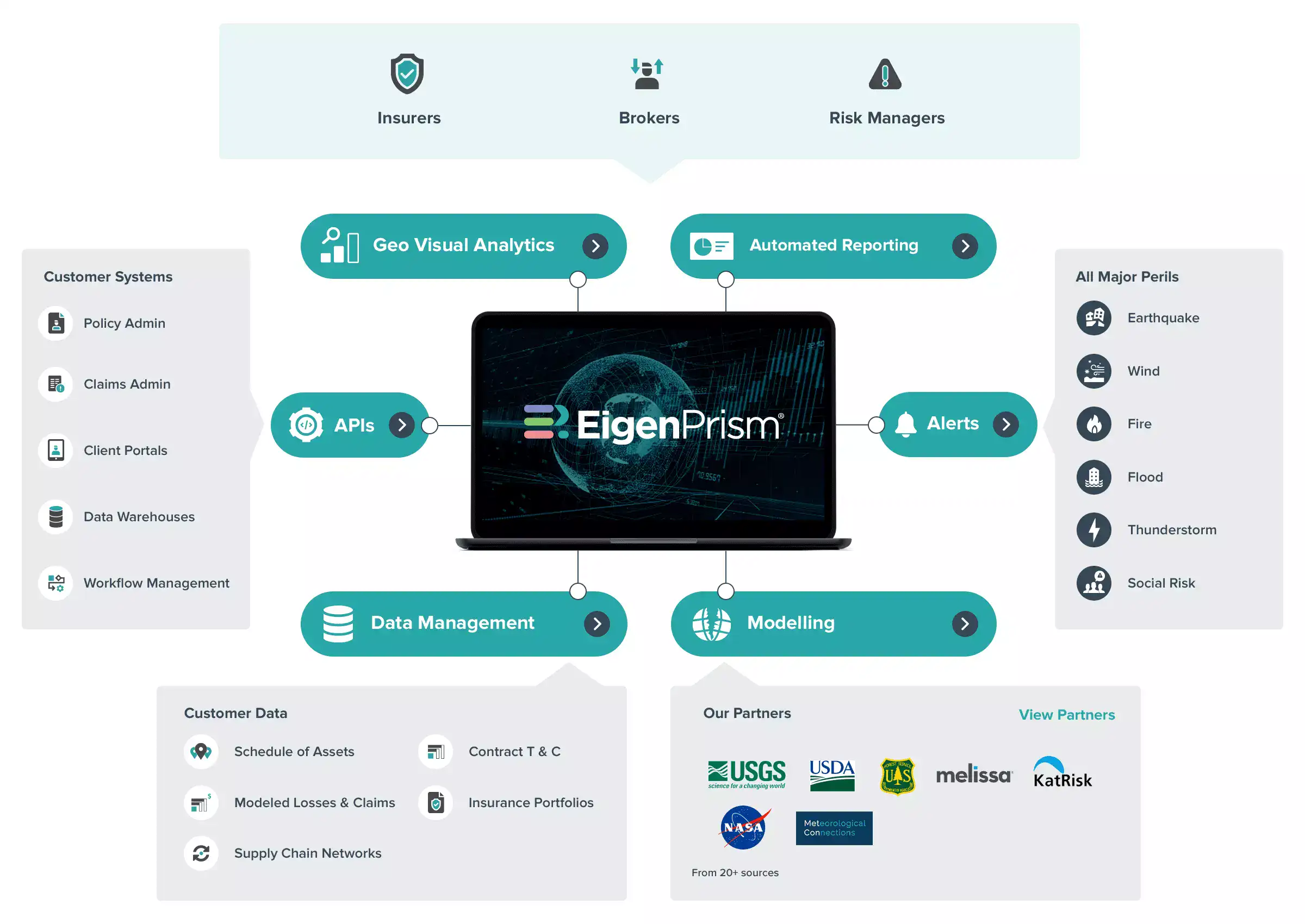
If you are managing large or frequently changing portfolios, EigenPrism’s APIs can automate your exposure data imports and updates so your data stays current without manual effort
Run a Data Quality Check
Use the exposure stratification analysis to spot gaps in your COPE data, geocoding accuracy, and replacement cost completeness at a glance. Incomplete data means incomplete analysis.
Augment What Is Missing
Use EigenPrism’s data augmentation through partners like HazardHub to fill in construction type, roof age, and replacement cost data. This is especially valuable for loss adjustment after an event.
Step 2: Know How a Major Outbreak Would Hit Your Book Before it Happens
Identify Accumulation Hotspots
Run a spider analysis to pinpoint where your risk is most concentrated. If a tornado outbreak tracks through one of those zones, you want to know that now.
To get a deeper understanding of your concentrated risk, run a custom shape spider analysis. It lets you analyze exposure concentration using custom shapes like event footprints, instead of just circles. Move these shapes along a grid system to find concentration patterns that better match real-world risk scenarios. The workflow follows the same steps as circular spider analysis.

Build What-If Scenarios from 2025 Events
Move last year’s tornado damage survey footprints (such as the March 14 to 15 outbreak path or the April 2 outbreak across Kentucky and Arkansas) over your current portfolio to model potential impacts. This takes minutes in EigenPrism and gives you a concrete view of how a repeat event would affect your book.

Run Frequency Maps
Overlay historical tornado and hail frequency data on your exposure. Launch a hazard overlay analysis from the hazard tab in the model catalog to see where your assets sit relative to historical severe weather activity.
Pull Your Climatology Reports
Two report templates in the report library are built for this:
-
Tornado Climatology Report: Annual tornado occurrence frequency based on SPC data across 5-year, 10-year, and 74-year windows.
-
Hail Climatology Report: Average annual hail days (1 inch or larger) based on the same SPC data across 5-year, 10-year, and 69-year windows.
Access both from the “Quick Add” button on your homepage under “Reports.”
Step 3: Make Sure Your Moratorium Criteria Keeps Pace with a Fast-Moving Event
If you use EigenPrism alerts to trigger underwriting moratoriums, review your thresholds before the season begins. Last year’s outbreaks reinforced that SCS events can escalate from outlook to confirmed damage in a matter of hours. Make sure your criteria reflect the speed and intensity of these events.
Step 4: Give Your Team Lead Time with Alerts
This is the simplest step and the most important one. Verify that your EigenAlerts are active, that your alert thresholds reflect your current risk appetite, and that the right people on your team are receiving notifications. During the March 2025 outbreak, EigenPrism users with alerts configured received notifications as soon as the NWS issued its Day 1 outlook, giving them critical hours of lead time.
Review and set your alerts now.
——————————————————————————————————————————
Check Out Our Upcoming Webinar
Severe Convective Storm: The New Costliest Insured Peril
Why speed, coverage, and accuracy matter now more than ever coming off a $50b SCS loss year
This webinar introduces a modern SCS event response framework built on three pillars: speed (updates delivered in hours, not days), coverage (even in unpopulated areas), and accuracy (high-resolution footprints validated against real outcomes). EigenRisk and Canopy Weather will walk through post-event response strategies that leading (re)insurers and MGAs are using to assess tornado, hail, and wind impacts faster and more accurately than traditional methods allow.

Join EigenRisk and Canopy Weather for a live session to discover how to respond faster, assess more accurately, and close your SCS event response gap before the next storm hits.