Beyond the Booth: Exposure Management Gaps and Secondary Perils Challenge the Industry, Plus More Takeaways from Instech Exponential Risk
London’s insurance community gathered for Instech’s Exponential Risk conference last week, and the conversations we had on the floor made one thing clear: the industry is still working through fundamental exposure management gaps while secondary perils continue to stress-test some workflows.
This year our attendees included Deepak Badoni (President and Co-Founder), Rebecca Morris (VP, Client Success), Jon Sonnenschein (Director, Sales), Toby Lempriere (Director, Customer Success), and Mehak Kaushal (Senior Manager, Solution Consulting). Below you’ll find their key takeaways, followed by a deep dive Q&A.
- Major carriers and reinsurers still lack enterprise-level solutions for exposure management, event response, and underwriting. Many rely on fragmented in-house tools that don’t communicate with each other.
- Secondary perils (SCS, wildfire, flood) are now treated as primary concerns, with SCS and wildfire dominating discussions about where blind spots exist.
- AI conversations shifted from skeptical to pragmatic, with organizations asking what can realistically be implemented in the medium term rather than dismissing it outright.
1). What was the dominant theme that came up most in conversations at Instech 2026?
Toby: Even though solutions like ours have been available for nearly a decade, I’m still surprised by how many large organizations lack a unified enterprise platform for exposure management, event response, and underwriting. What I see instead is heavy reliance on large vendors positioned as catch-all solutions. This often stems from internal challenges: limited subject matter expertise to drive adoption or shifting priorities that continuously delay implementation. The result is the same. Teams are working harder than they need to because the right infrastructure isn’t in place.
Jon: Secondary perils like SCS dominated conversations, as usual. There’s a belief that hurricane risk is well understood, which I worry might reflect recency bias. We’ve had some quiet seasons, but that never lasts. One severe season will remind everyone how quickly those assumptions can break down.
Mehak: The biggest theme was the lack of cohesive infrastructure for exposure management and event response. Most companies have in-house tools serving different functions, whether it’s exposure tracking, underwriting, or post-event response, but nothing connects them. At the same time, secondary perils like SCS, wildfire, and flood kept coming up. The message was clear: climate is making these perils harder to predict and manage, and existing tools aren’t keeping pace.
2). What surprised you most at Instech 2026, something you did not expect to hear or see?
Mehak: There still aren’t purpose-built solutions for reinsurers. It’s a significant market, but most reinsurance teams are managing catastrophe risk using legacy methods that haven’t evolved much. The gap between what’s available and what’s actually needed is substantial.
Rebecca: Mindfulness sessions at an insurance technology conference were a pleasant surprise. I think it speaks to how the industry is thinking about talent retention and wellness in new ways.
3). Do you feel the industry has started treating secondary perils as primary concerns? What is your read based on what you heard?
Jon: Absolutely. Everyone believes they have hurricane risk figured out, but SCS and wildfire are treated differently. There’s an awareness that blind spots exist, and teams are actively looking for better ways to manage them.
Mehak: Yes, clearly. Hurricane risk is well understood at this point, but SCS and wildfire are where the real uncertainty lives. These perils are driving consistent losses, but the adoption of tools and processes to manage them haven’t caught up to the frequency or severity we’re seeing.
Deepak: I’m not sure I’d say SCS is being treated as a primary peril, but what people need is changing. Primary perils will always command the most attention and the most rigorous modeling effort. But what has changed is that the industry is more open to alternative analytical approaches for secondary perils – accumulation analytics, shape-based analysis, real-time event response – because the traditional modeling confidence is not at the same level. That openness is what’s new, and it matters.
4). How was AI being discussed at Instech 2026 compared to previous years?
Toby: The conversation has shifted from skeptical to pragmatic. There’s still plenty of hype, but businesses are now asking more specific questions about what can be implemented in the near term and what results they can expect. That’s progress.
Jon: Most people weren’t bringing it up in meetings. We shared what we’re working on, and the response was balanced. There’s excitement, but also healthy skepticism. That’s the right mix for this stage.
Mehak: People weren’t leading with AI questions, but when we brought up specific use cases and showed how it applies to their workflows, the interest level was high. The technology is moving from abstract concept to practical tool, and that shift is becoming visible.
Deepak:The conversationis getting more pragmatic and maturing past hype. Organizations are now asking practical questions about what AI can really do for them, how it might integrate with or improve existing workflows, and what measurable outcomes could be. That’s a significant shift from even a year ago.
What is the one insight you want readers to take away from Instech 2026?
Toby: “If you’re not first, you’re last.” The companies moving quickly on exposure management, event response, and AI integration are establishing the standard everyone else will be measured against. The gap between leaders and followers is widening, and catching up gets harder every quarter.
Deepak: “Mind the gap.” There’s a widening disconnect between current industry practices and the technology that’s available today for exposure management and event response. The companies that close that gap quickly will have a competitive advantage.

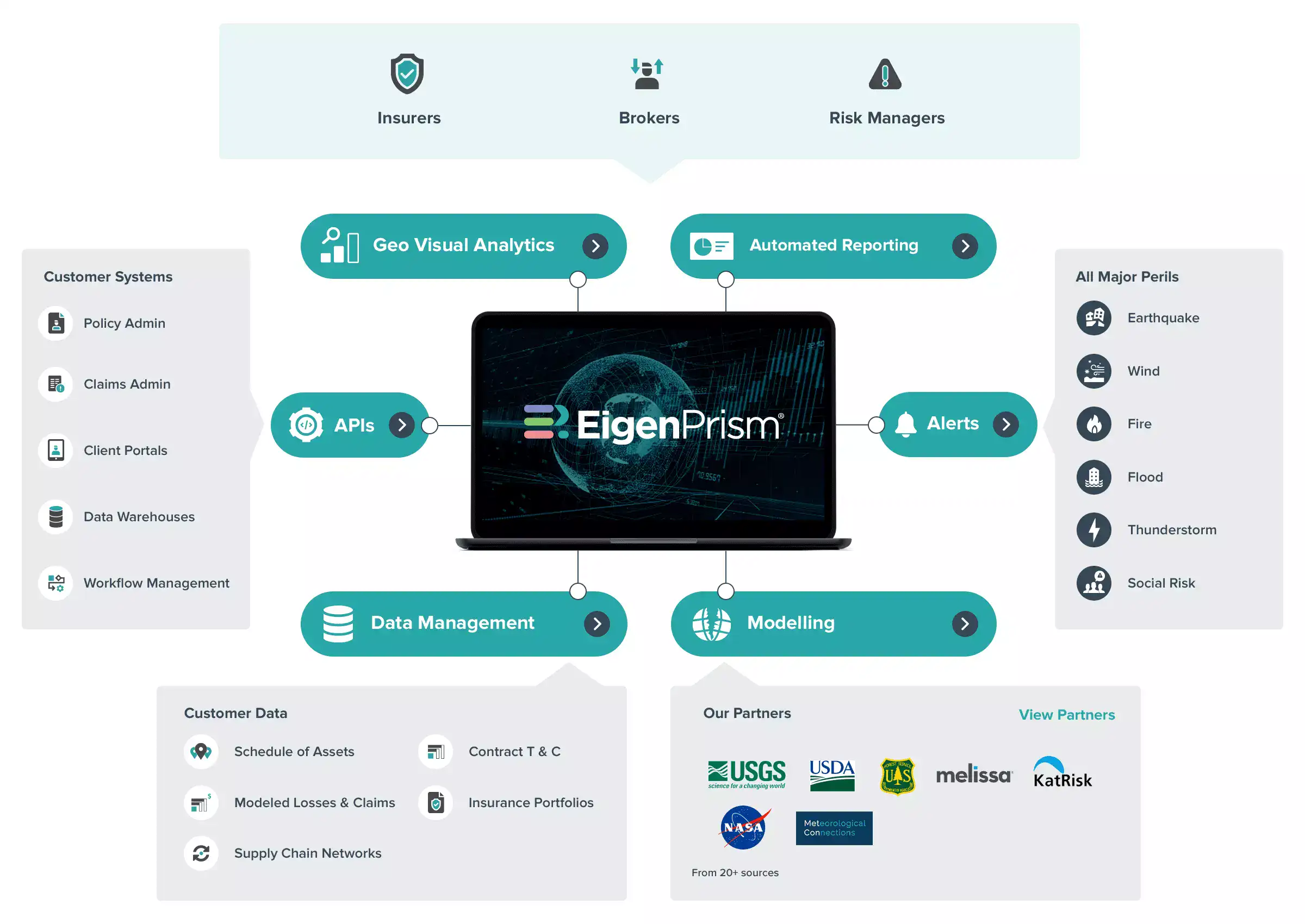
To learn more about how EigenPrism supports catastrophe event response and exposure management, contact us.