Beyond the Booth: What We Heard at RAA 2026 and What It Means for the Year Ahead
Kicking off the year with the RAA conference is something our team always looks forward to. Sure, leaving our cold, snowy climates for the Orlando sunshine doesn’t hurt, but the real pull is all of the conversations we know we’ll get to have with the experts roaming the halls.
This year our attendees included Deepak Badoni (President and Co-Founder), Rebecca Morris (VP, Client Success), Jon Sonnenschein (Director, Sales) and Toby Lempriere (Director, Customer Success). Below you’ll find their key takeaways, followed by a deep-dive Q&A.
- Severe Convective Storm (SCS) has officially outgrown the “secondary peril” label and re/insurers and MGAs are actively looking for better tools to manage it.
- AI is evolving from buzzword to genuine business question, but solutions and implementation aren’t quite there yet.
- Event response is emerging as a front-door conversation rather than an afterthought. The market is also getting more specialized, with new MGA entrants and a growing awareness of geopolitical risk adding texture to an already complex landscape.
1. What are re/insurers and MGAs looking to understand from technology in 2026?
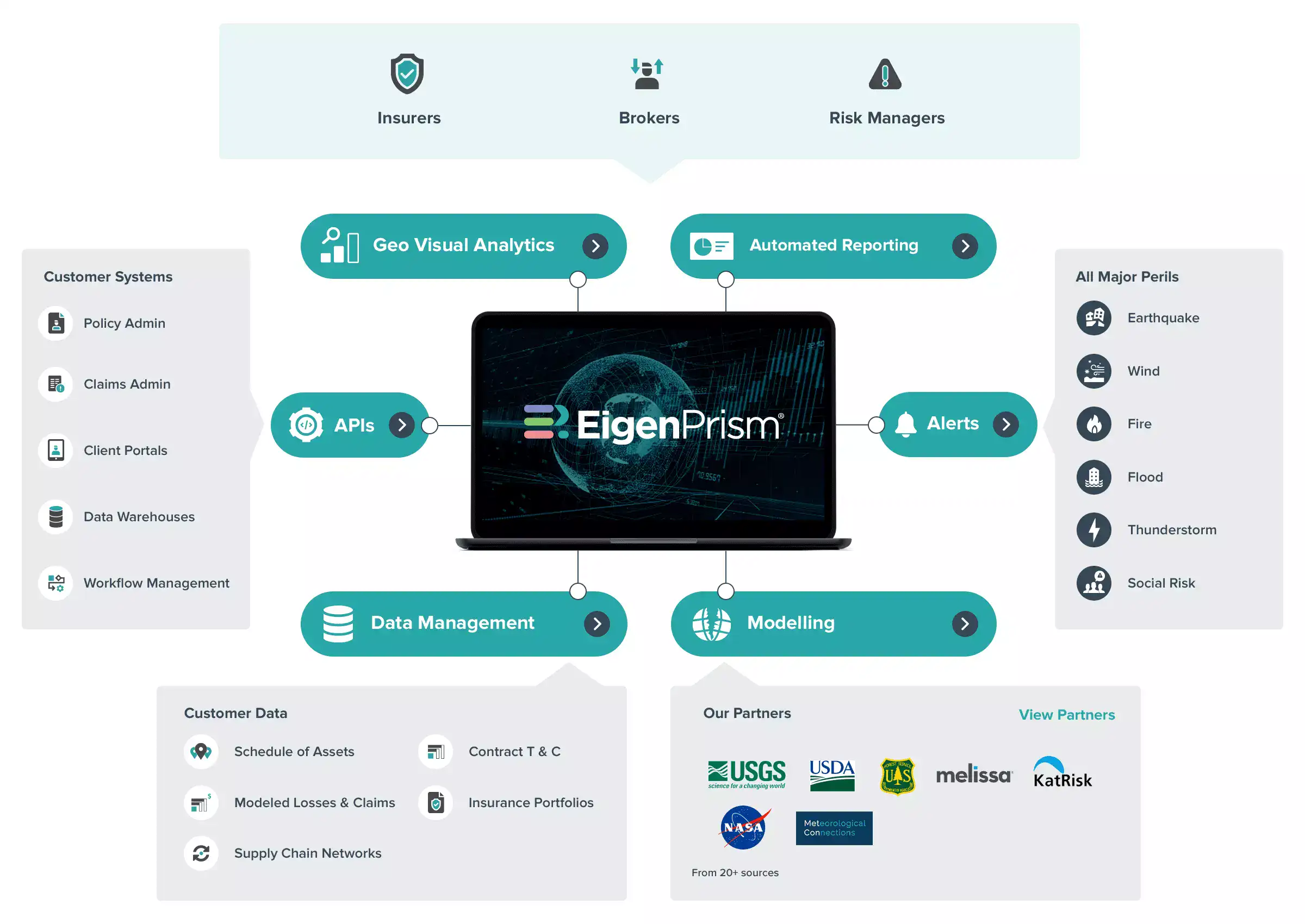
Toby: A lot of people wanted to understand connectivity across the data provider ecosystem. They wanted to know where we (EigenPrism) sit relative to other data and technology providers in the insurance workflow. There is real appetite for understanding how the ecosystem fits together, not just what any individual company does.
Rebecca: I overheard a significant amount of AI discussion happening around me. It was clearly on people’s minds.
Jon: The data ecosystem question came up constantly — who is partnered with whom, and what that means for buyers.
Deepak: I was intentional about raising AI in my conversations because I’m curious where the market is on this. I’m pleased to say the reception was largely positive. What was clear is that most people now have access to AI tools in some form. The question has shifted from “what is this” to “what can it actually do for us.”
2. What genuinely surprised you that you did not expect to hear or see this year?
Jon: Honestly, I was surprised that winter storm was not a bigger conversation given what had just happened in New York. I expected that to be front of mind and it was not.
Deepak: The level of interest in event response was surprising in a good way. Typically, I hear about event response in the context of exposure management or claims, and even then, it tends to be secondary to underwriting and cat modeling. At RAA this year, a meaningful number of conversations opened with event response as the leading pain point. That tells me something about where urgency has shifted, particularly around SCS, wildfire, and flood.
3. Sounds like SCS was a big topic. Do you think the industry has genuinely started treating secondary perils as primary concerns?
Rebecca: Yes. The shift is real. Everyone has a mature process for hurricane at this point. SCS is the peril people are actively trying to figure out because old processes aren’t holding up. They need to know how to understand it faster, how to respond to live events faster, and how to build better workflows around something that moves so rapidly and hits their books of business hard.
Toby: This evolution has been underway for several years, but it is more openly acknowledged now. We went through this with flood first, then wildfire. Now SCS is the peril where people are actively seeking better data to support live event tracking, underwriting decisions, and exposure management. The conversations are more specific and more urgent than they were even twelve months ago.
Jon: SCS is so sudden and so frequent that it is genuinely difficult to manage without purpose-built tools. Most people feel relatively prepared for hurricane because they have the tools they need to know it is coming so they can plan around it. SCS doesn’t have that same foresight or runway.
Deepak: I’m not sure I’d say SCS is being treated as a primary peril, but what people need is changing. Primary perils will always command the most attention and the most rigorous modeling effort. But what has changed is that the industry is more open to alternative analytical approaches for secondary perils – accumulation analytics, shape-based analysis, real-time event response – because the traditional modeling confidence is not at the same level. That openness is what’s new, and it matters.
4. How did the AI conversation feel compared to previous years?
Rebecca: Last year, people were curious about AI, but nobody could understand how it might help. This year, many had used AI tools themselves, so the conversation was more grounded. People were asking about direct applications, like what it does inside a workflow, not just what it is in theory. I could tell that people are more excited about it and they’re ready to see it in action for their use cases.
Toby: The claims have been circulating for a few years now, with various companies asserting they have AI built into their point solutions. What is different in 2026 is that people are asking about scale, wanting to understand how it can work across a business, not just in one function? There is also a visible divide opening up between companies moving fast on this and those still watching. That gap is going to matter.
Jon: My read was more measured. Most of what I saw was internal productivity tool adoption. It’s getting light use, but I don’t see signs of rapid adoption in our industry yet.
Deepak: The industry operates as a relatively closed ecosystem. Deep expertise lives in established workflows and long-standing vendor relationships. AI has the potential to open that up in the same way SaaS did a decade ago by creating space to innovate in areas that have been locked in place for years.
5. What is the one thing you want readers to take away from RAA 2026?
Rebecca: “Anxiety starts when an event happens and before you know how bad it is going to be. EigenRisk shortens that timeline.” That came from a conversation with a client on the floor, and it has stayed with me. That is the real value proposition, stated plainly.
Jon: One of our clients said that we are THE solution for the next generation of event response, and biased as I may be, I have to agree!
Deepak: Our industry is at an inflection point. AI is not a distant consideration anymore, it’s arriving, and it will disrupt a closed ecosystem that has not seen that kind of disruption in a long time. The companies thinking about this now will have an advantage over those who wait until it is obvious.
The EigenRisk team attends RAA annually. To learn more about how EigenPrism supports catastrophe event response and exposure management, contact us.