Takeaways from RAA’s 2024 CAT Risk Management Conference
Q&A with Deepak Badoni, President, EigenRisk, Inc.
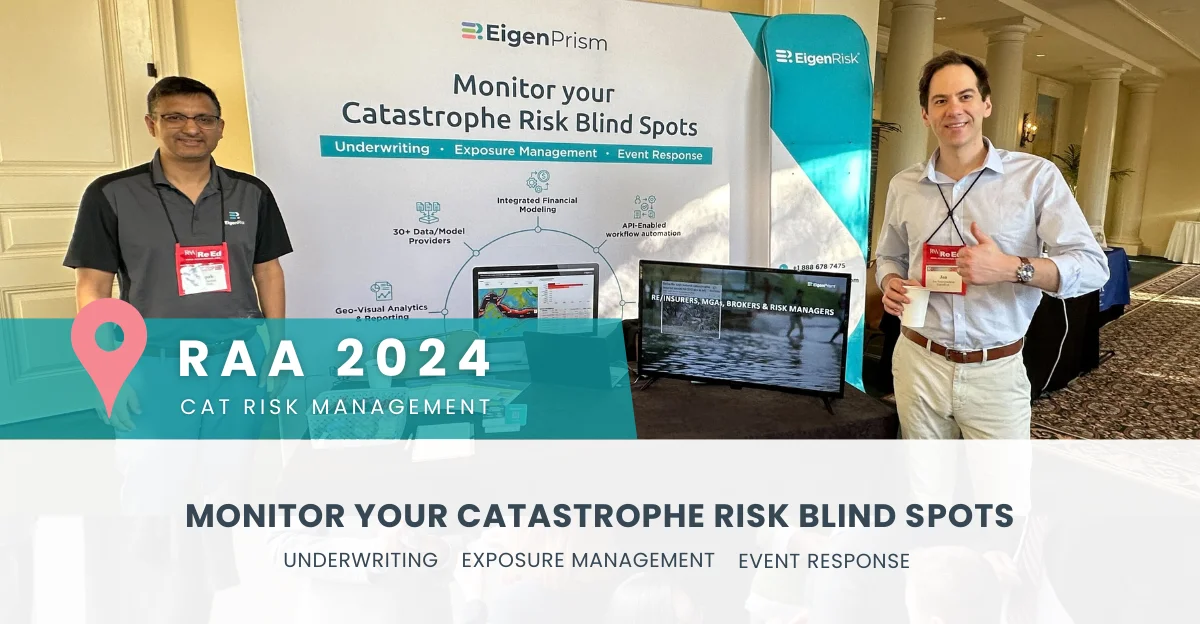
The Reinsurance Association of America (RAA) held its 2024 CAT Risk Management Conference in Orlando last month. Its theme: It Starts with Science. In a Q&A discussion, Deepak Badoni offers his perspective on key developments and takeaways from this year’s program.
1. What was top of mind for the CAT risk/modelling community at RAA this year?
Of course, many of the discussions centered around major perils such as hurricane and earthquake. This year, however, there was a growing focus on secondary perils, such as SCS, wildfire and flood. And there was debate about whether these events can even be considered secondary perils anymore – especially as we’re seeing more widespread and significant hail and severe weather events than in the past.
Predictably, there’s more buzz about AI and its role in our industry, and general calls for better, more scientific modeling.
2. There was a lot of talk about hail and severe weather … do you really think we’re in for another record-breaking year?
At EigenRisk, we tend to stay away from forecasting, as an independent technology platform with multiple models sourced from our various partners. That said, one of our partners, Canopy Weather, has recently published an analysis forecasting another year of significant storm activity. Maybe not a record-breaking year, but it seems like we’ll be in for another severe year – indeed, while we were at RAA, tornados were ripping through my home state of Ohio!
3. There was a decent amount of talk about AI, what are your thoughts on it in our industry?
Today, AI comes up in nearly every conversation about catastrophe modeling. Yet, the challenge with AI is separating the hype from the real benefit. Some of our partners, such as Reask and Tensorflight are already leveraging AI to great effect in specific aspects of their solutions. However, I’m skeptical about any claims of fully AI-driven forecasting. At this point, there isn’t a sufficient volume of quality data to train an end-to-end AI model in our space. Another wrinkle: Current generation AI is known to amplify any inherent biases in the data. Our industry is widely aware of the various drawbacks to “black box modeling”… and at this point, AI is the ultimate “black box”.
4. Some new and emerging data providers/CAT modeling companies these past few years … any to keep an eye out for?
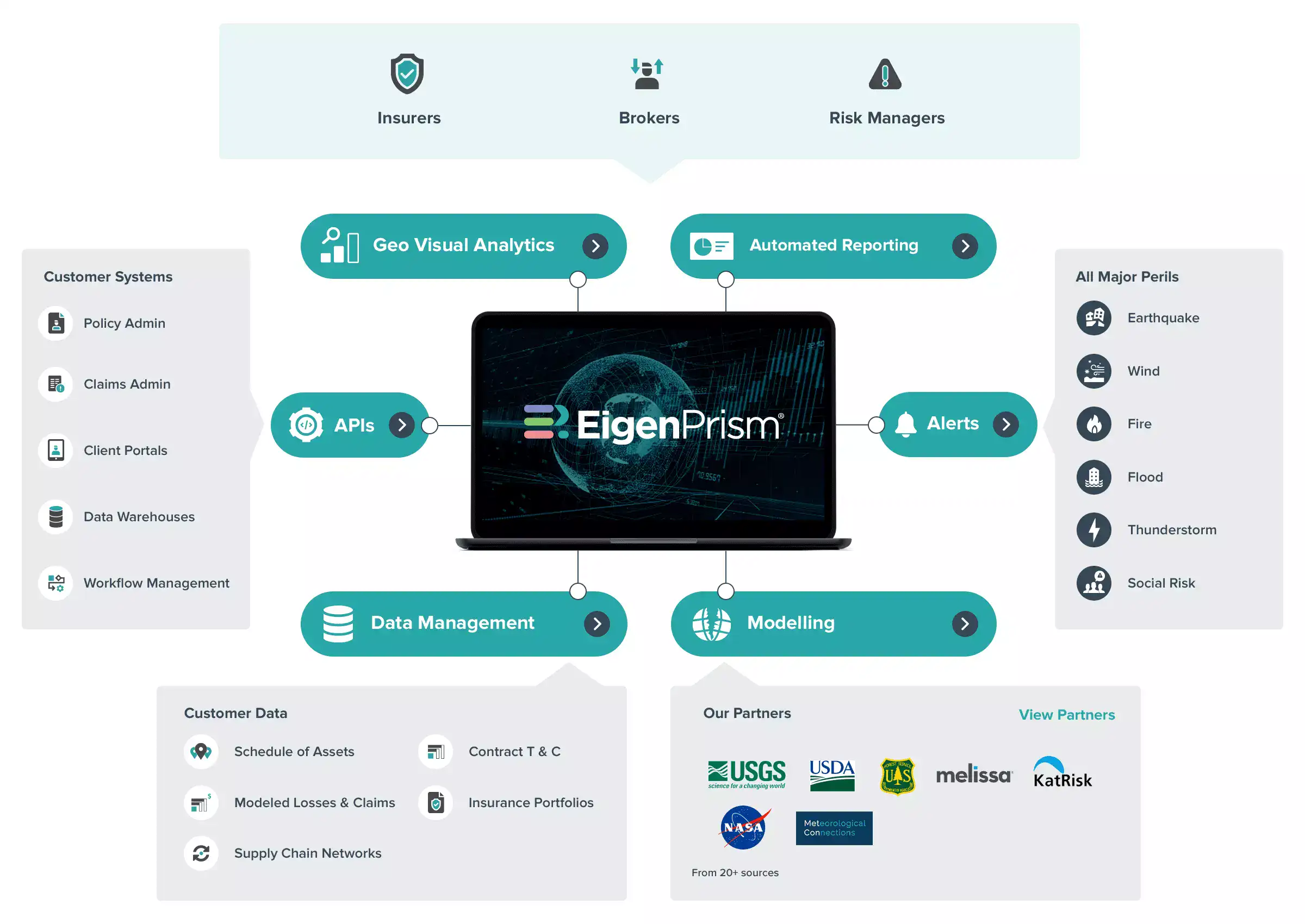
While there are a growing number of exciting innovators in this space, we obviously think we are partnered with some of the best minds in the business: Reask, ICEYE, Canopy Weather, KatRisk, Teren, Tensorflight, and Fathom.
5. As our industry continues to innovate, there is still a heavy reliance on government/public data. Can you share your thoughts on this and if you see the industry moving away from this, or, perhaps helping the government innovate themselves?
The industry will always rely on government data to provide a basic benchmark, but we’re increasingly seeing the use of private third-party data to generate more scientific, accurate and timely analyses of unfolding risks events and hazard assessments.
Keep in mind that most government datasets and solutions have been designed primarily for life/public safety. As such, these datasets err on the side of conservatism and sometimes intentionally provide qualitative rather than quantitative information.
Many of our private partners have done a great job of layering on more quantitative information better suited for insurance decision making. For example, you can always find the cone of uncertainty and hurricane track information on NOAA’s site, which can be useful if you’re trying to set evacuation guidelines. However, what you really need to estimate losses is the wind gust footprint, that is not publicly available. We have multiple data partners that provide this information, some down to 1 km resolution.
6. Institutional modelers have dominated the space (and the RAA event, itself) for decades now … curious if you think there is a broader wave of change happening with folks who are challenging these institutional firms?
Absolutely, in the past decade some brilliant minds have come together to create newer models that are challenging the status quo, but they are often limited to a specific set of perils or by region. Platforms like ours are now leveling the playing field for these modelers to compete head-to-head across all perils and regions. They also offer the ability to “mix and match” models from different providers.
We also see companies starting to leverage API integrations between multiple platforms to create seamless workflows for underwriting, exposure management and event response.
Contact Us
Learn more about our catastrophe risk management platform – EigenPrsim: